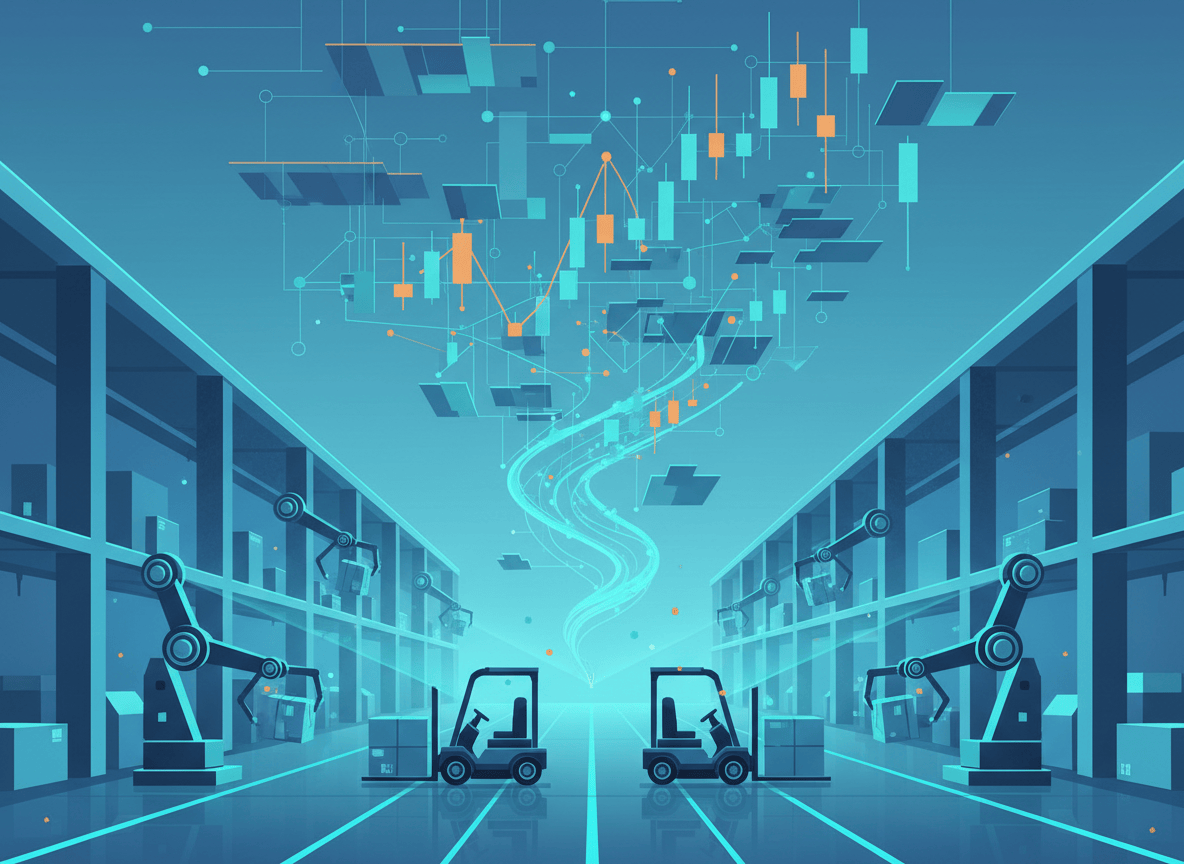
Gartner just mapped the AI maturity curve for warehouses. It’s tempting to file that under “operations problem, not my problem” if your world is trading desks, risk systems, and chartering rather than pick paths and conveyor belts. That would be a mistake. The framework Gartner published on September 16 isn’t really about forklifts — it’s about how an organization earns trust in increasingly autonomous AI, one tier at a time. That sequencing discipline applies just as directly to CTRM/ETRM and supply-chain risk systems as it does to a distribution center floor.
Four Tiers, One Maturity Curve
Gartner’s research groups warehouse AI into four converging trends, ranked by how independently a system can act and how sophisticated its reasoning is:
- Enhanced optimization-oriented traditional AI — rule-based, transparent models sharpened with real-time data for demand forecasting, labor planning, and inventory management.
- Operational-driven generative AI — synthesizes unstructured data into dynamic work instructions and decision support embedded directly in daily operations.
- Suggestive and semi-autonomous agents — recommend or partially execute a workflow while a human still owns the critical call.
- Physical AI agents — AI, robotics, and sensors combined to automate picking, packing, and material handling with real precision.
Notice the shape of that list: it isn’t four unrelated technologies, it’s a ladder. Each tier assumes the discipline of the one below it — clean data and transparent optimization before generative insight, generative insight before an agent gets to act on it, and an agent proving itself before it’s trusted with a robot arm or a live trade.
Labor Constraints as the Inflection Point
Gartner frames this as an inflection point driven by three things converging at once: persistent labor shortages, more affordable automation financing, and AI/autonomous technology that’s finally mature enough for real operational use — not just pilots. Senior analyst Federica Stufano’s guidance is the part worth underlining: organizations should “tackle proven use cases, such as labor forecasting and slotting, and expand into generative AI and agents where it can improve decision-making,” while keeping human oversight in place as new applications are evaluated.
That’s a deliberately unglamorous prescription. Start where the AI is boring and provably correct. Earn the right to get more autonomous.
The Freight Floor Is Already Living This
A day after Gartner’s release, freight-tech vendor Loadsmart put tier three into production at scale. Its newly launched AI agents don’t just recommend actions — they sense load requirements, decide, execute, and report back into existing systems, autonomously resolving the large majority of routine freight tasks. Six specialized agents split the work: document collection and classification, carrier tracking, re-tendering failed loads within cost guardrails, proactive load audits, claims documentation, and dock scheduling.
The interesting design choice isn’t the automation — it’s the exit ramp. When a load hits a genuine exception — damage, a disputed charge, a relationship issue — it routes to a human. “You own the results; the work comes off your plate” is the vendor’s own framing, and it’s a tidy real-world example of Gartner’s tier three: semi-autonomous, but never unsupervised where judgment actually matters.
The Sequencing Discipline That Transfers to Trading and Risk
Map this same ladder onto a CTRM or ETRM environment and it holds up well:
- Tier one is exposure calculation, position reconciliation, and price/volume forecasting done with explainable, rule-based models — the stuff that has to be right before anything else is trusted.
- Tier two is generative AI turning scattered contract terms, broker notes, and market commentary into a usable brief for a trader or risk manager, rather than acting on its own.
- Tier three is an agent that matches trade capture against confirmations, flags settlement exceptions, or drafts a hedge recommendation — with a human still signing off before anything touches a book.
- Tier four is narrow, bounded autonomous execution — think auto-hedging a small delta within pre-approved limits — only after the lower tiers have earned trust through a track record, not a demo.
Skipping straight to tier three or four because a vendor demo looks impressive is exactly the mistake Gartner’s framework is designed to prevent — in a warehouse or on a desk.
What This Means for Trading and Supply-Chain Risk Teams
Three practical takeaways for anyone evaluating AI in trading, risk, or logistics systems right now:
- Map current or planned AI initiatives against the four tiers honestly — are you building the foundation, or shopping for tier three capability without tier one in place?
- Keep an explicit human checkpoint on anything touching settlement, credit, or delivery commitments, the same way Loadsmart routes exceptions to a person rather than letting the agent guess.
- Treat labor and headcount pressure as the honest reason to adopt AI, not a narrative built after the fact — Gartner’s own inflection-point argument holds for trading operations facing the same staffing constraints as warehouses.
Gartner built this roadmap for pick paths and conveyor belts. The discipline underneath it — narrow first, human oversight preserved, autonomy earned in stages — is the same discipline that decides whether AI in trading and supply-chain risk systems earns a permanent seat at the desk, or gets quietly shelved after the pilot ends.

