Corn (Zea mays) is far more than a staple vegetable on dinner tables around the world. In the global macro-economy, corn is an absolute juggernaut—a strategic commodity that powers industries, feeds massive livestock networks, and drives multi-billion-dollar trading volumes on global exchanges every single day.
Whether you are an agricultural enthusiast, an investor, or a commodity trader, understanding the mechanics behind the world’s most heavily traded grain is essential. This comprehensive deep dive breaks down the global corn market from the ground up, highlighting its structure, supply chain, and critical pricing factors.
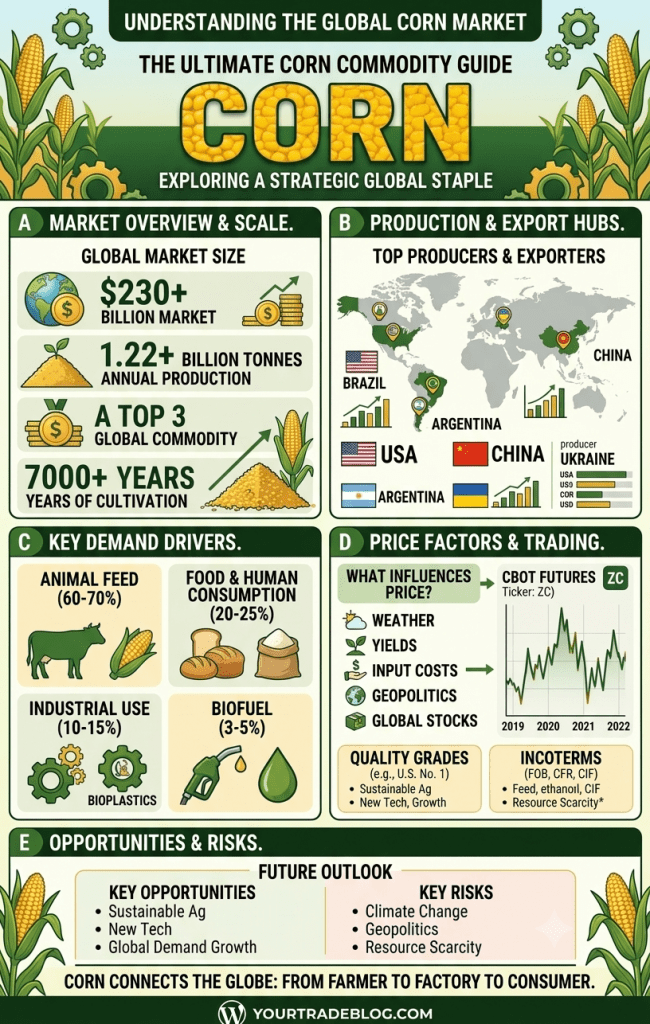
1. The Global Scale: A $230+ Billion Market
Corn is cultivated on almost every continent, but its commercial market is highly concentrated. With an annual global production estimated at roughly 1.22 billion tonnes, the global corn market value comfortably exceeds US$ 230 billion.
While demand spans across every timezone, production and trade are heavily dominated by just a few powerhouse nations:
The Producers & Exporters: The United States stands as the undisputed global leader in both corn production and export volume, followed closely by Brazil. Argentina, Ukraine, and the European Union round out the other major exporters. Interestingly, China is one of the world’s top producers but exports almost none of it, consuming its entire supply internally.
The Net Importers: Driven by massive populations and booming industrial needs, China leads the world in corn imports, followed by Mexico, Japan, the European Union, and South Korea.
2. Versatility in Action: Where Does All the Corn Go?
When we look at the industrial breakdown of corn usage, a surprising reality emerges: humans eat only a fraction of the corn grown worldwide. The crop’s true value lies in its sheer industrial versatility, broken down into four primary pillars
Animal Feed (60% – 70%): By far the largest demand sector. Corn is the number one grain used globally to feed poultry, swine, cattle, and aquaculture operations. As global meat consumption rises, the demand for feed corn scales proportionally.
Food & Human Consumption (20% – 25%): This represents the direct consumer market—everything from cornmeal, corn starch, and flour to sweeteners (like high-fructose corn syrup), breakfast cereals, and snack foods.
Industrial Applications (10% – 15%): Corn starch is converted into specialized binders, bioplastics, paper products, textiles, and various industrial alcohols.
3. Deconstructing the Corn Supply Chain
The journey of a corn kernel from a seed to an international cargo ship is a highly complex logistical operation. . breakdown of the pipeline reveals five distinct stages:
Biofuel (3% – 5%): A heavily policy-dependent sector, where corn is processed into ethanol and blended directly into commercial gasoline supplies to meet clean energy mandates.
Input Supply:
The foundational stage involving specialized seed genomics, fertilizers, crop protection chemicals, and heavy machinery.
Farming: The physical cultivation cycle, which is highly reliant on moisture management, soil health, and precision agriculture.
Harvesting & Handling: The mechanical reaping, field-drying, cleaning, and commercial silo storage.
Transportation: Moving bulk grain requires immense infrastructure. Corn relies heavily on multi-modal logistics, moving via trucks to local rail networks, down river barges, and eventually onto ocean-going vessels.
Processing & End Use: The final destination where mills, biorefineries, and feed factories turn raw kernels into consumer-ready products.
Logistics Rule: In agricultural commodities, logistics dictate profitability. Efficient storage and moisture control are critical to preventing spoilage and keeping international shipping lines running smoothly without costly delays.
4. What Drives Corn Prices and Market Volatility?
Corn prices fluctuate constantly on global exchanges, most notably on the Chicago Board of Trade (CBOT) where it trades under the futures ticker symbol ZC. Understanding what moves these prices requires keeping an eye on two contrasting forces:
The Supply Side
- The Weather Formula: In the trading pits, the golden rule is simple: Weather + Yield = Volatility. Severe weather events like droughts, late frosts, or floods in the US Midwest or Brazil can instantly erase millions of expected tons, spiking prices.
- Input Expenses: Because corn is a input-intensive crop, spikes in the cost of fertilizer (nitrogen/potash) and diesel fuel instantly squeeze farming margins and reduce the total acreage planted.
- Geopolitics: Regional conflicts can cripple major export corridors overnight—as observed with Black Sea disruptions affecting Ukrainian grain shipments.
The Demand Side
- Livestock Trends: Economic growth in developing countries shifts consumer diets toward higher protein, triggering an immediate surge in international feed demand.
- Government Policies: Mandates requiring higher ethanol percentages in consumer fuels or unexpected import tariffs can instantly shift standard trade flows.
5. Forward Outlook: Challenges & Opportunities
Looking toward the next decade, the corn market is bracing for structural shifts. Balancing macro risks against emerging technologies will determine the asset class’s profitability.
Emerging Challenges
- Climate & Scarcity: Intensifying global weather swings and groundwater depletion present ongoing yield risks.
- Regulatory Squeezes: Tightening environmental laws regarding fertilizer usage and land management are challenging traditional farm outputs.
- Crop Biosecurity: Evolving pests and localized crop diseases require continuous, costly seed innovation.
Major Opportunities
- Regenerative Agriculture: Global supply chains are increasingly shifting toward sustainable, low-carbon farming practices to capture premium prices.
- Bioproduct Innovation: The steady replacement of petroleum-based plastics with corn-derived bioplastics offers an entirely new structural demand avenue.
- Yield Technology: Advanced gene editing and precision, AI-driven farming analytics are allowing growers to extract more bushels per acre than ever before.

