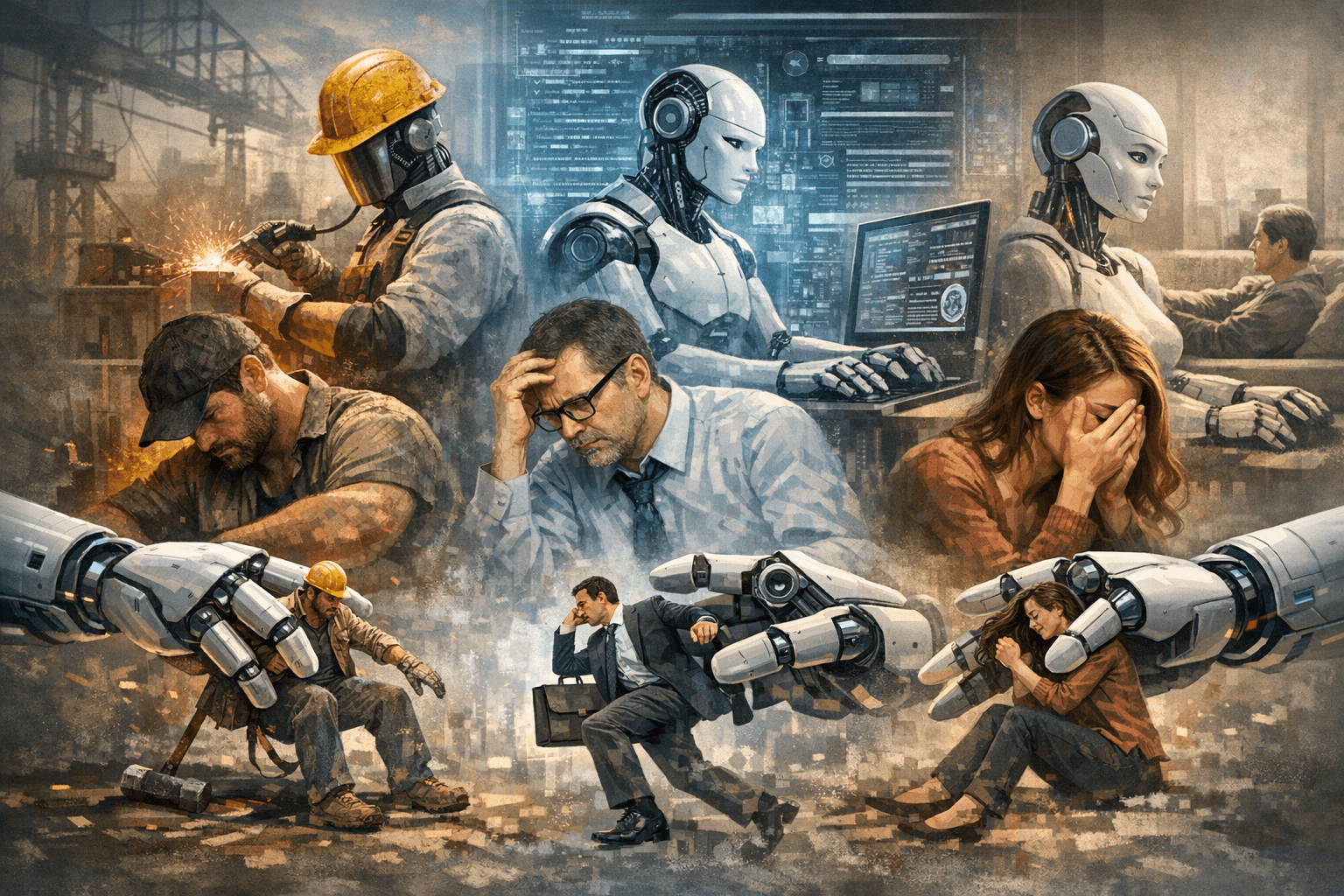
While whole world is talking about AI and how transformative it is revolutionizing industries, including our very own livelihood as humans. Here is my take on this..
For centuries, we’ve operated under a comfortable assumption: humans possess a unique set of “edges” that machines simply cannot touch. We’ve built our identities, our economies, and our sense of worth around these advantages.
But as we look at the rapid evolution of technology, that once-guaranteed upper hand is fundamentally challenged.
To understand where we stand today, we have to look at the Human Quotient—the 4 core dimensions of our potential—and how AI is systematically encroaching on each one.
The Four Pillars of the Human Quotient
Historically, our value has been defined by the interplay of four dimensions:
1. PQ (Physical Quotient): Our strength, stamina, and manual dexterity.
2. IQ (Intelligence Quotient):Our logic, problem-solving, and cognitive processing.
3. EQ (Emotional Quotient):Our empathy, social intuition, and emotional management.
4. SQ (Spiritual Quotient):Our sense of purpose, ethics, and “the why” behind our existence.
As we trace the arc of human history, we see a clear pattern: machines are moving up the ladder, one quotient at a time.
1. The Fall of the Physical Edge (PQ)
For the vast majority of human history, PQ was king. If you were stronger, faster, or had more stamina, you held the advantage. This dominance lasted until the Industrial Revolution. Suddenly, steam and steel could do the work of a thousand men. As machines took over the heavy lifting, our physical might cease to be a primary differentiator in the modern economy.
2. The Information Age and the IQ Shift
With physical tasks automated, the world shifted its focus to IQ. In the twentieth century, success was defined by how well you could process information, innovate, and solve complex problems. We built an entire global infrastructure—from Ivy League universities to the tech hubs of Silicon Valley—based on the value of human intelligence.
However, the digital age has brought a sobering reality: AI is winning the IQ race. Through machine learning and the recent explosion of Generative AI, machines now surpass us in pattern recognition, data analysis, and even creative problem-solving. In fields driven by pure logic and information processing, the human edge is rapidly diminishing.
3. The Newest Frontier: The EQ Challenge
Until very recently, we held onto EQ as our “final fortress.” We believed that even if a machine could calculate faster than us, it could never feel or connect.
We were wrong.
In the current AI age, even our emotional advantage is under threat. We are seeing AI systems that can:
* Identify subtle emotional cues in voice and facial expressions.
* Mimic empathy with startling accuracy.
* Provide emotional support that users find as compelling (or more so) than human interaction.
When machines can simulate the “human touch” in therapy, customer service, and companionship, even our emotional roles are being reshaped.
It has penetrated to the extent that a Girlfriends/wife feel better talking to Genai tools who are better at consoling, caring, reminding her birthday or anniversaries..
Don’t you get it!!! we are losing it man….
So, What’s Left?
If machines have conquered our strength (PQ), are outthinking our logic (IQ), and are now mimicking our hearts (EQ), what remains?
This leaves us at a profound crossroads. As the “Human Quotient” faces this encroachment, we are forced to look deeper—perhaps toward that final dimension, the Spiritual Quotient (SQ)—to redefine what it actually means to have a human edge in a world where we are no longer the fastest, the smartest, or even the most “empathetic” entities in the room.

The question is no longer “What can we do better than machines?” but rather, “Who are we when machines can do it all?”
What do you think is the last “human-only” skill? Join the conversation in the comments below.

