Building modern software is a lot like constructing a complex skyscraper . It’s not just one big block of code; it’s a meticulously planned structure made up of interconnected layers, each specializing in a vital function. Understanding these layers is key to designing, developing, and scaling robust applications.
Here’s a breakdown of the 9 essential layers that form the blueprint for today’s most successful applications, from the screen you tap to the server farm running the show:
The User-Facing Layers (The Experience)
These layers are all about delivering content and ensuring a smooth user journey.
* Presentation Layer (UI/UX): This is the front door of your application. It’s what users see and interact with—the layout, buttons, forms, and visuals. The goal here is usability and a seamless user experience (UX). Tools often include React, Vue, Angular, or native mobile frameworks.
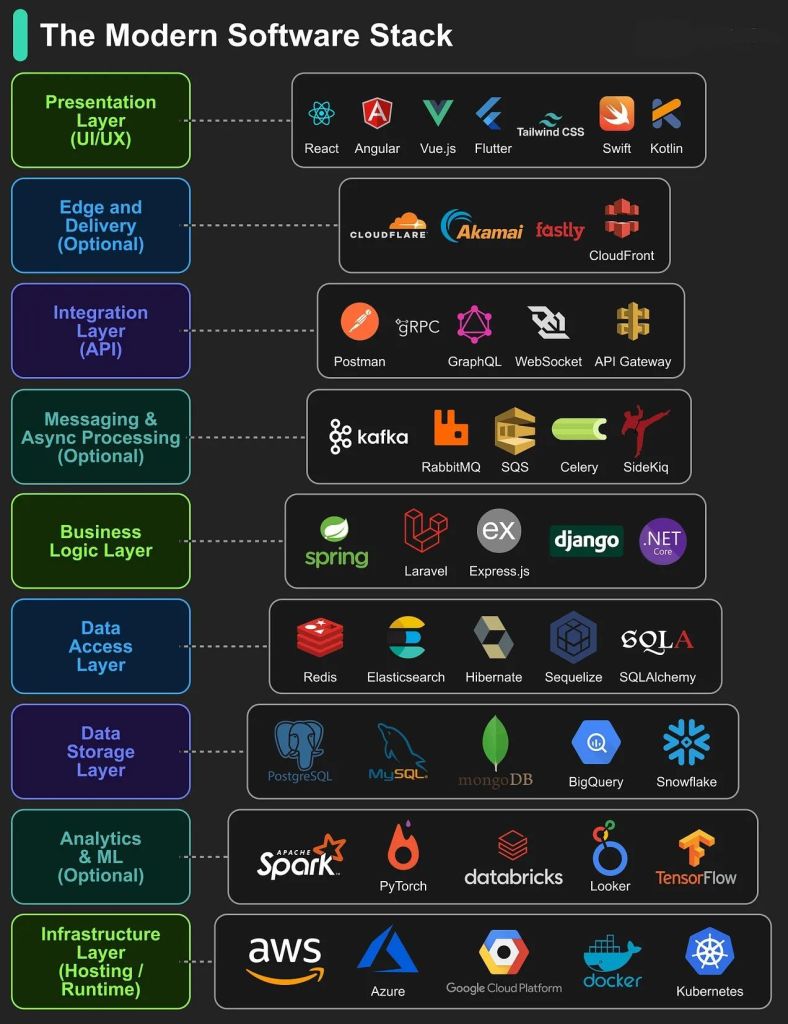
* Edge and Delivery (Optional): Think of this as the fast lane for your content. Using Content Delivery Networks (CDNs), this layer places static content (images, videos, etc.) physically closer to users worldwide. This dramatically reduces latency and speeds up load times.
The Intercommunication Layers (The Connectors)
These layers ensure that different components of the system can talk to each other effectively.
* Integration Layer (API): This is the language translator for your system. It defines a set of Application Programming Interfaces (APIs)—the contracts for how services exchange data. It’s what enables interoperability, whether you’re connecting a mobile app to a backend service or integrating with a third-party payment system.
* Messaging & Async Processing (Optional): For tasks that don’t need an immediate response (like processing a large report, sending an email, or handling a payment queue), this layer steps in. It uses message queues or streaming platforms to process events asynchronously in the background, which significantly improves scalability and keeps the main application responsive.
The Core Layers (The Brain and Memory)
This is where the application’s intelligence and data reside.
* Business Logic Layer: This is the brain of the application. It contains the core rules, workflows, and decision-making processes that define what your application actually does. If your application calculates taxes, validates an order, or determines a shipping route, that logic lives here.
* Data Access Layer (DAL): The DAL is the bouncer between your business logic and your stored data. It abstracts the complexities of the database, ensuring that data is retrieved, created, updated, and deleted securely and efficiently without the business logic needing to know the specifics of the database technology.
* Data Storage Layer: This is the memory of the application. It includes all the databases (SQL, NoSQL, graph, key-value stores) used to reliably store, organize, and manage both structured and unstructured data.
The Intelligence and Support Layers (The Enhancers)
These layers provide additional functionality and the foundation upon which everything runs.
..
* Analytics & ML (Optional): Modern applications often go beyond simple storage. This layer involves analyzing stored data to generate powerful insights, predictions, and intelligent features (like recommendations or fraud detection). This is where Machine Learning (ML) models live and operate.
* Infrastructure Layer (Hosting / Runtime): This is the foundation and plumbing for the entire stack. It provides the computing environment, resources, and operational tooling needed to deploy, run, monitor, and scale the application. This includes everything from physical servers to cloud services (AWS, Azure, GCP), containers (Docker, Kubernetes), and serverless functions.
Why Does This Map Matter?
Understanding these nine layers is crucial because it promotes the principle of Separation of Concerns. By isolating functions into distinct layers:
* Developers can specialize and work on one layer without disrupting others.
* Architects can select the best-fit technology for each specific job.
* The entire system becomes easier to scale, maintain, and update over time.
In the complex landscape of modern software, knowing where you are on this 9-layer map is the first step toward building something truly scalable and sustainable.
 AnalystGuru - Everything Analysis