Key Contract Types in Commodity Trading
In the dynamic world of commodity trading, contracts are more than paperwork—they’re strategic tools that define risk exposure, pricing mechanisms, and supply chain agility. Whether dealing in physical commodities or derivatives, understanding these agreements is essential to managing operations effectively.
Here’s an overview of the main types of commodity contracts every trader should know:
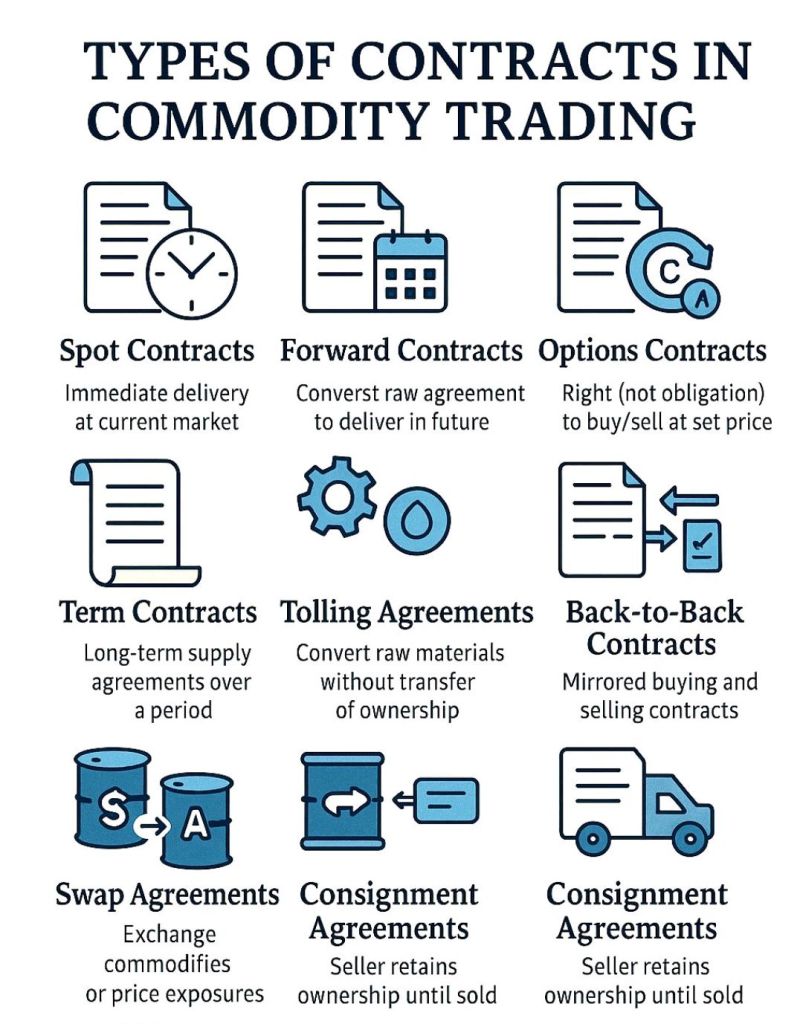
Spot Contracts
Transactions settled immediately at the prevailing market price, ideal for quick trades in liquid markets.
Forward Contracts
Customized agreements between two parties for future delivery at a predetermined price—widely used to lock in costs or revenues.
Options Contracts
Offer the right (but not the obligation) to buy or sell at a fixed price. Useful for hedging while preserving flexibility.
Term Contracts
Long-term agreements covering regular supply over months or years. Common in sectors like energy and agriculture for ensuring continuity.
Tolling Agreements
Involve processing raw materials provided by one party while ownership remains unchanged. Often used in refining or manufacturing setups.
Back-to-Back Contracts
Mirror deals with counterparties that help manage exposure across both ends of a transaction—frequently used in arbitrage scenarios.
Swap Agreements
Contracts to exchange commodities or pricing terms (e.g., fixed for floating). Critical in managing financial risk and market exposure.
Consignment Agreements
Goods are placed with a buyer or distributor, but ownership remains with the seller until the product is sold. This supports working capital efficiency.
These contracts are integral to building robust trading strategies, managing price volatility, and maximizing profit margins.
 AnalystGuru - Everything Analysis