You all must be having this question in your mind about.
What is a CTRM Software
CTRM (Commodity Trading and Risk Management) software is specialized trading and risk management software designed for companies involved in commodity trading. Commodity trading is the buying and selling of commodities, the movement and delivery of those commodities, and the associated risk management activities for those commodities.
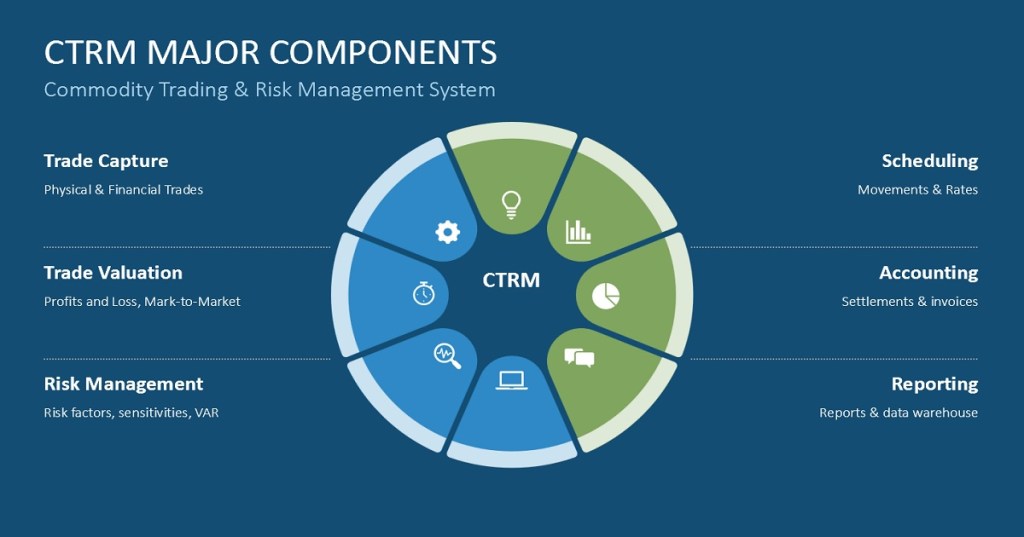
Commodity traders, processors and purchasers use CTRM software to manage physical trades, accounting, derivative trades, position, mark to market, origination, logistics, risk management, procurement, planning and scheduling. CTRM softs can be used for all asset classes, including agriculture (coffee, cocoa, grains, oilseeds, sugar, rubber, palm, etc.), energy (crude and refined products, natural gas, natural gas liquids, liquefied natural gas, power, coal, renewables), and metals (base metals, refined, steel, scraps, and concentrates).
CTRM solutions vary depending on which commodities are traded, which assets are employed in the business, where those assets are located and what the company’s business strategy and associated business processes are.
Many of the companies try to adapt to an ERP and try to use it like a CTRM software but ultimately, they fail on their way as there are lot of nuances which a ERP cannot handle and only a CTRM software can handle and bridge those gaps required for a commodity trading domain.
Commodity management is complicated, and using a system designed for generic business purposes to accommodate all the nuances of commodity management just doesn’t work. While CTRM software and ERP have many common ingredients, they are fundamentally different. The architecture of commodity trading risk management software has been built with the specific needs of commodities companies in mind. ERP systems cannot handle all the unique situations that can occur in commodity management, like, for example, pricing.
Pricing
Unlike most manufacturing businesses where the price of goods is known throughout the supply chain, unpriced and partially priced positions cause core differences in the way a commodity is bought, sold, shipped, stored, invoiced, accounted for, and valued throughout the supply chain. The way commodities are priced and valued sits at the architectural centerpiece of what a commodity management system needs, and this impacts practically everything throughout the commodity supply chain.
With no defined price, creating a contract in an ERP system is challenging. And, there are so many price types (unpriced, index, NPE, etc.) as well as exchange types that provide creative market prices (hourly, daily, monthly, etc.). ERP cannot handle provisional, prepayment, and final invoices or deal with mark-to-market valuations and constantly changing market prices.
hope you liked this week’s article. stay tuned for more.
#CTRM#happylearning#derivatives#OTBS
 AnalystGuru - Everything Analysis