Introduction
Goals provide us a sense of direction. They help us focus and promote a sense of personal satisfaction. By setting goals, we can create a roadmap showing us how to achieve the target. It helps create a plan based on how and where we need to focus our time to achieve the set goals and track progress made. While building our careers, we may want to get a certain promotion or reach a particular milestone. Setting goals will help us do so.
To help you set career goals and objectives for yourself, you can use a framework known as SMART goals.
What are SMART goals?
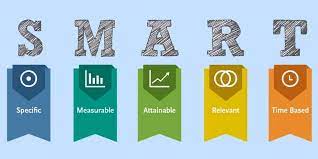
SMART goals stands for Specific, Measurable, Achievable, Relevant, and Time-based.
These goals are typically used in personal development, career growth, project management, and employee performance management. This framework was developed by Arthur Miller, George Doran, and James Cunningham in 1981, and it is still relevant today. Every element helps us create goals that are carefully planned, trackable, and concise.
Have you ever been in a situation where you created a set of goals but weren’t able to achieve them in the best possible way? Setting SMART goals will help you eliminate this problem. Poorly planned goals can be vague and unachievable. Working towards goals that are not crafted well can also make us feel like we are underachieving. However, setting SMART goals will help us solve these problems, be it professional or personal goals. Setting a strong foundation is the key to success. Now that we know the smart goals full form, let us understand how we can convert a line such as “I want to be a leader” into an achievable goal through a step-by-step process:
- Make it specific
- Make it measurable
- Make it achievable
- Make it relevant
- Make it time-bound
S = Specific
Being as specific as possible will give you clarity on what you wish to achieve. Narrowing down your goal is essential to understanding how it can be achieved. For example: Instead of saying that you want to become a leader, say, I want to earn a manager position at an ed-tech startup.
M = Measurable
For us to achieve a goal, we need to be able to measure it. What proof do we have that we are making progress towards the goal? In the previous step, we have set a specific goal. How can we measure if we are moving closer towards it or not? Setting measurable milestones will help you reevaluate and change your course of action if required. Give yourself credit where it’s due, and appreciate your efforts when you make progress towards the goal. An example of a measurable goal in terms of the previous point would be: “I will apply to four open positions for a managerial position at an ed-tech startup.”
A = Achievable
Before actually working towards the goal, we must evaluate it to understand if it is achievable. Can the goal be accomplished within a particular period? If we look at the same example as above, we need to have the qualifications to apply for the position. Do you have the required skills, knowledge, and work experience required to accomplish the goal? Can the skills required be learned over time? Are there any steps to be taken to be better prepared? Ask yourself these questions, and set a goal that is achievable. For example: “I will update my resume with the relevant qualifications to apply to four open managerial positions at an ed-tech startup.”
R = Relevant
All of us have certain long-term goals or plans. We follow a set of core values. In this stage, we must assess whether our goals are relevant to our future plans and align with our values. If personal or career goals do not align with your long-term goals, you can consider rethinking your plans. Ask yourself some questions, understand why the goal is important to you, and how it will contribute to your overall growth to help you achieve your long-term goals. Following the same example, we can say that: “To achieve my goal of becoming a manager, I will upskill to learn the required skills and update my resume with the relevant qualifications to apply to four open managerial positions at an ed-tech startup.”
T = Time-based
As the name suggests, think of a time frame within which you would want to achieve your goal. Ensure that this time period is realistic. Let’s say you want to earn a promotion, give yourself a fixed period such as six months. For example: “To achieve my goal of becoming a manager, I will upskill to learn the required skills and update my resume with the relevant qualifications to apply to four open managerial positions at an ed-tech startup within this week.”
Advantages
- SMART goals are not vague
- Their odds of being achieved are increased because they are specific
- They allow us to track our progress
- SMART goals provide us a timeline in which we can adjust and revisit our goals
- They are realistic
Disadvantages
- There are small chances that individuals may get obsessive about their plans
- Increase cravings for more achievements, and thus, you may enter a vicious cycle of wanting more
- Making SMART goals may be overly ambitious for some people
Why should I use SMART goals?
We have seen what SMART goals mean. But why should we use them? These goals help us set boundaries and also indicate the progress we’ve made. It helps us achieve goals more effectively as well as with efficiency. Let us take a look at a few examples of SMART goals.
Examples of SMART goals
Let’s assume that person A wants to shift their career from customer service to design, person B wants to become a marketing manager but doesn’t know where to start, and person C wants to work in the entertainment sector. How will these individuals set their SMART goals? Let us understand through some examples.
Example 1
“I will get a job as a college History teacher within four months of graduating with my Bachelor in Education.”
- Specific: The goal is to become a history teacher in college is well-defined
- Measurable: Possible to measure success based on the number of interviews/job offers
- Achievable: The person who has set up this goal has the appropriate educational qualifications for the same
- Relevant: After getting a degree in education, the individual wishes to work in the field of education
- Time-based: The individual has given themselves four months of time to complete their goal
Example 2
“I will get promoted to a senior marketing manager role by completing the required training in the net five months and by applying for the role at the end of the quarter”
- Specific: The individual has set their goal to be promoted to a senior marketing manager
- Measurable: Possible to measure success based on whether the training module is completed and whether the individual applies for the role
- Achievable: The person who has set up this goal has the appropriate training qualifications for the same
- Relevant: The individual plans to apply for the promotion post completion of the training module, which shows that they are interested in the field and wish to work long-term
- Time-based: The individual has given themselves time till the end of the quarter to complete their training and apply
Conclusion
To move forward in our career or achieve personal developments, having a plan of action is advisable. Setting a SMART goal will help you move forward in an organized manner and provide the required structure
 AnalystGuru - Everything Analysis